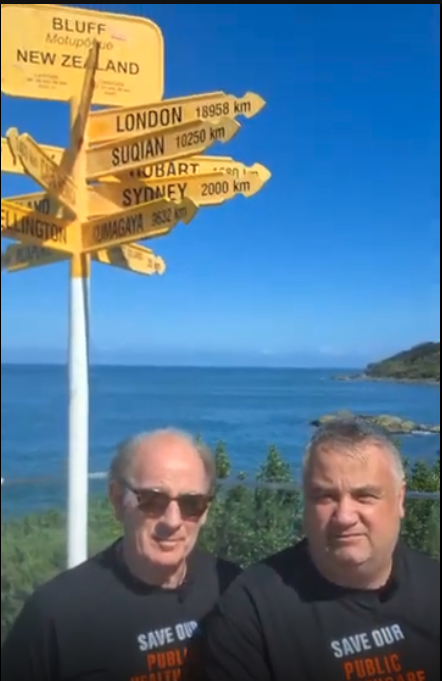
Ramblings from the roady - Dr David Galler’s diary
David Galler and Malcolm Mulholland are making their way from Bluff to Cape Reinga on the Save Our Public Health Roady.
Along the way, David's been keeping notes on the people they meet, the things they hear, and whatever else catches his attention.
We'll keep adding them here as the Roady heads north.
Day 3 | Timaru: Teeth, hospitals and the cost of neglect
Two conversations in Timaru stood out, and both paint a troubling picture of what happens when we fail to invest in prevention and public healthcare.
The appalling state of our children's teeth
Timaru dentist Fraser Dunbar spends far too much of his time pulling out teeth. And it doesn't need to be this way.
Despite children having access to free dental care, fewer are receiving it. We're desperately short of dental therapists, and those still working are overwhelmed.
Too many children are missing out on routine dental care, only to end up needing far more serious treatment.
Fraser described children waiting months for treatment, sometimes with badly decayed teeth. The consequences go well beyond dental pain, affecting their eating, sleeping, learning and development.
He also described a dramatic increase in the need for dental treatment under general anaesthetic in South Canterbury.
And it's not just children. More young adults in their twenties are asking to have all their teeth removed.
In Christchurch, Fraser reported a huge increase in people presenting with facial swelling from dental infections. He believes a free, 24-hour dental service could cost less than what we're currently spending dealing with the consequences of untreated dental disease.
We know what helps: fluoridation, reducing sugar consumption, toothbrushes and toothpaste, early support for families, and making sure children can access the dental services they're entitled to.
Prevention is not complicated. But it does require investment.
Timaru Hospital: A zombie hospital?
Peter Doran described a hospital under enormous strain.
His words were blunt: a zombie hospital.
Years of underinvestment in buildings, staffing and systems have taken their toll.
Plans for a new hospital have faded, leaving a partially completed refurbishment. Some areas have been improved, but other wards remain in a disgraceful condition. Operating theatres have seen little improvement in 17 years, and Peter raised serious concerns about the intensive care unit.
Although, apparently, it has the best view.
The hospital is desperately short of beds and specialists, with general medicine, paediatrics, obstetrics and gynaecology, psychiatry and anaesthesia all under pressure.
Patients are being cared for in unusual parts of the hospital. Elective procedures are cancelled. Staff are exhausted.
Recruitment delays make everything worse, while significant sums are spent on locums instead of building a stable workforce.
And then there are the things we don't measure.
The Government is focused on targets, but targets don't necessarily tell us whether people are getting good care.
Support and administrative staff who once kept hospitals running have been cut, leaving clinicians to pick up the work. These were often the people who knew how everything worked and quietly held the system together.
One nurse with 30 years' experience said she'd never seen things this bad.
Goodwill is being drained from the system.
The centralisation of Health New Zealand has also meant the loss of local knowledge and accountability, including the community voices once heard through local health boards and advisory groups.
The message from Timaru
From children needing teeth extracted to a hospital struggling under years of neglect, the message is clear.
We cannot keep waiting until people are seriously unwell before we act.
We need to invest in prevention, our health workforce and the public services our communities depend on.
Day 2 | Gore and Ōtepoti
Following on from the terrific conversations in Waihōpai, several themes have already emerged.
1. People are grateful to be heard.
People have told us how grateful they are that we've come to listen to their ideas and concerns, and hear what they have to say.
2. There are excellent community-based services doing remarkable work.
In each place we've visited, we've found community-based services that have emerged to meet local needs, although the support they receive varies.
There's clearly a great deal to learn from these models, and much that could work well if adapted to different communities.
What a shame Health NZ isn't here with us!
3. Access to hospital and specialist services is a massive issue.
Access to hospital services, specialist advice and treatment is a huge concern for Southlanders.
“Don't get sick in Southland.”
That was the message we heard loud and clear.
Day 1 | Waihōpai Invercargill
What a gem.
Ngā Kete Mātauranga Pounamu Charitable Trust is an extraordinary organisation providing wraparound, kaupapa Māori-based services to the people of Invercargill and Bluff.
They offer a huge range of health and social services, many at low or no cost, including mental health and addiction counselling, restorative justice, navigational support, the He Puna Waiora Wellness Centre, stop smoking support and the Bluff Community Medical Centre, which provides low-cost access to doctor services.
None of that is easy. Their success is built on the relationships they foster with their community.
Like Whānau Ora, there is so much to learn from their model. There is a genuine interest in helping their clients and patients in the round: asking about the wider whānau, the son who is struggling, or the aunt who has lost her husband.
It is so much more than the transactional exchange many people experience with their healthcare provider.
A huge thanks to CE Tracey Wright-Tawha for welcoming us, and to my Roady mate Malcolm Mulholland.
Ngā Kete Mātauranga Pounamu: https://nkmp.maori.nz/