From Bluff to Kaitaia: A Health System at Breaking Point
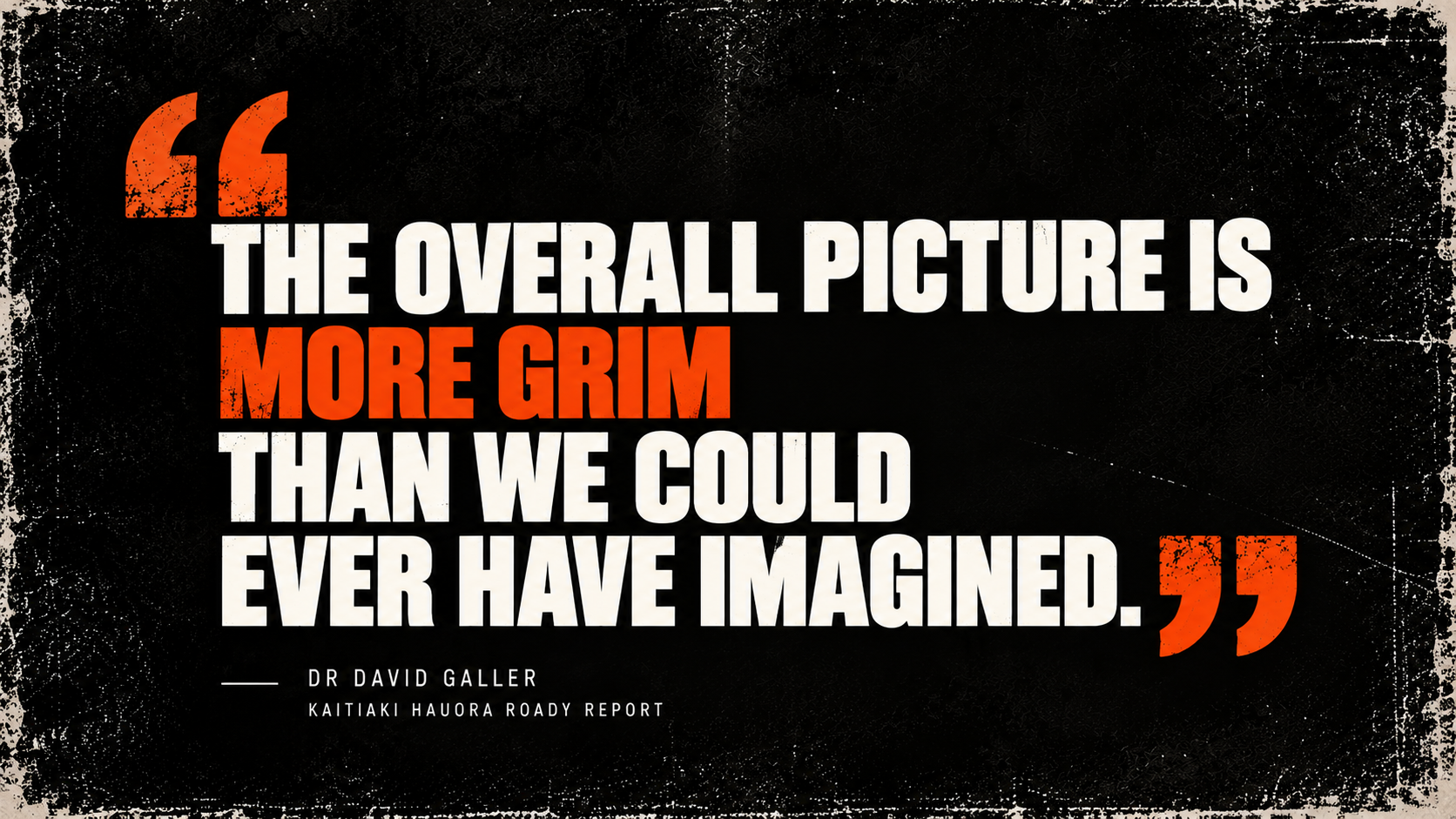
Over two weeks, Kaitiaki Hauora visited 27 locations from Bluff to Kaitaia and found a picture of public healthcare more grim than we could ever have imagined.
What patients, whānau, communities and health workers told us about the state of public healthcare in Aotearoa.
We went to listen. What we heard was deeply disturbing.
With so many reports of healthcare failures hitting the media, Kaitiaki Hauora's Dr David Galler and Dr Malcolm Mulholland travelled from Bluff to Kaitaia to hear directly from people using and providing healthcare across the country.
Over two weeks, they visited 27 locations, holding midday and evening meetings in towns and cities along the way.
Most meetings were small, with attendance ranging from three to 100 people, but more frequently around 20. Each meeting began with introductory remarks from David, Malcolm and one or two local speakers, before opening the discussion to everyone attending.
The smaller gatherings allowed for personal, deep and meaningful conversations. People shared their experiences openly, often with strangers, in a safe space.
David described being reminded of conversations with patients and their families during his clinical career, when people who had begun as strangers left feeling they had formed a genuine bond.
The welcome was humbling. People were grateful that someone had come to listen.
The key findings
Across the country, Kaitiaki Hauora heard a consistent and deeply concerning story.
A system in disarray. Health services are struggling, with little coordination between providers and no clear overall plan for how services should work together.
People feel abandoned. Patients, whānau and communities struggle to access care, while health workers feel unsupported and excluded from decisions affecting their work.
A workforce under pressure. Staff shortages, burnout, resignations and an atmosphere of intimidation are undermining the ability of health workers to provide good care.
Primary care in crisis. GP shortages, long waiting times, high fees and growing corporate involvement are making it increasingly difficult for people to access essential healthcare.
Mental health and dental services failing to meet need. Communities described overwhelmed or absent mental health services and a preventable crisis in children's oral health.
Privatisation is a major concern. People expressed strong support for public healthcare and concern about the consequences of increasing private provision.
Good services exist, but their lessons are being missed. Kaupapa Māori and community-led services stood out as examples of effective, locally responsive care.
People want a plan. Communities want long-term planning, proper funding, coordination and a health system that works for them.
A system in disarray
New Zealand's health system has been under pressure for years, but what Kaitiaki Hauora heard across the country points to a dramatic deterioration during the term of this government. Our assessment is one of neglect and growing chaos, with people increasingly concerned that political and ideological decisions are undermining an already struggling public health system.
Rather than operating as a coordinated system, health services and agencies are increasingly working in isolation. Decision-making is disconnected from the realities of everyday care, services are struggling to cope, and patients and health workers alike describe a profound loss of trust.
Despite widespread frustration and hopelessness, there is also growing anger and a determination to see things change. People want more than short-term fixes. They want proper funding, long-term planning, better coordination and political consensus around a public health system that works for everyone.
Te Tiriti, kaupapa Māori care and the services getting it right
Some of the most encouraging examples of healthcare encountered on the Roady were kaupapa Māori and community-led services providing accessible, culturally safe care for Māori and Pākehā alike. They demonstrated what can be achieved when services are designed around the needs of the communities they serve, reinforcing a fundamental principle: cultural safety is patient safety.
Throughout the journey, Kaitiaki Hauora heard no opposition to the need to honour Te Tiriti o Waitangi. The constitutional, ethical and evidence-based case for kaupapa Māori healthcare and cultural safety appeared widely accepted, including in rural Southland.
Three services stood out: Ngā Kete Mātauranga Pounamu in Invercargill and Bluff, Aupōuri Ngāti Kahu Te Rarawa Trust in Kaitaia, and NorthAble Matapuna Hauora in Northland. Their approaches offered valuable examples of locally responsive care, yet there was little evidence of Health New Zealand systematically identifying successful models and supporting other communities to learn from them.
At a time when so much of the health system is under pressure, these services offer something important: examples of what is already working and deserves greater support.

People feel isolated and abandoned
One of the strongest themes throughout the Roady was gratitude. People welcomed the opportunity to share their experiences and questioned when Health New Zealand had last taken the time to listen to their communities. As one person put it, “They think they know what is best for us and tell us what to do.”
Patients, whānau and communities described feeling abandoned and struggling to access the care they need, often at their most vulnerable. Healthcare workers and local providers expressed similar frustrations, describing services operating in isolation, with little understanding of who provides what, how services are funded or how they are supposed to work together.
Without clear coordination or planning at local, regional or national level, people are left trying to navigate a confusing and fragmented network of services. Providers themselves struggle to identify what resources are available, where the gaps exist and who is responsible for addressing them.
Health workers are burning out, leaving and afraid to speak
Health workers across the country described an atmosphere of intimidation, growing mistrust of government and Health New Zealand, and frustration at decisions being made by people disconnected from the realities of clinical care. Despite their commitment to patients, many feel powerless to influence the conditions in which they work, with little confidence in workforce planning or the future of public healthcare.
Staff shortages, increasing workloads and burnout are driving experienced clinicians into private practice, overseas or out of healthcare altogether. Those who remain feel increasingly undervalued, treated as costs rather than essential assets, while obvious workforce gaps go unfilled and expensive temporary solutions, including locums, are used instead of addressing underlying problems.
The New Zealand Health Charter was identified as a potential way to address some of these concerns, but that opportunity is now seen as lost.
Primary care: the Wild West
Primary care should be the foundation of our health system, yet communities across the country described a fragmented and increasingly difficult service to access. GP practices are full, waiting times are growing, and some people have no access to a GP at all. Patients reported high after-hours fees, difficulty getting diagnostic tests and specialist advice, and having to chase up their own results, some of which had been lost.
With many GPs approaching retirement and increasing corporate ownership of practices, providers described a system shaped more by market forces than coordinated planning. They raised serious concerns about inadequate funding, overwhelming administrative demands and the difficulties of recruiting and retaining GPs, particularly in rural communities.
Primary care providers called for greater investment, better access to hospital specialists and diagnostics, and locally appropriate workforce solutions. They also questioned why GP specialists are not paid on comparable terms to hospital specialists. When patients are referred for specialist care, they should be assessed rather than simply sent back to their GP. Instead, the growing barriers between primary and hospital care are leaving both patients and practitioners frustrated and losing trust in the system.
Children's dental health: a preventable crisis
Dentists across the country described alarming levels of tooth decay among children, with growing demand for hospital operating theatres to carry out dental extractions under general anaesthetic. Much of this suffering, and the pressure it places on hospitals, could be prevented through better access to dental care and early intervention.
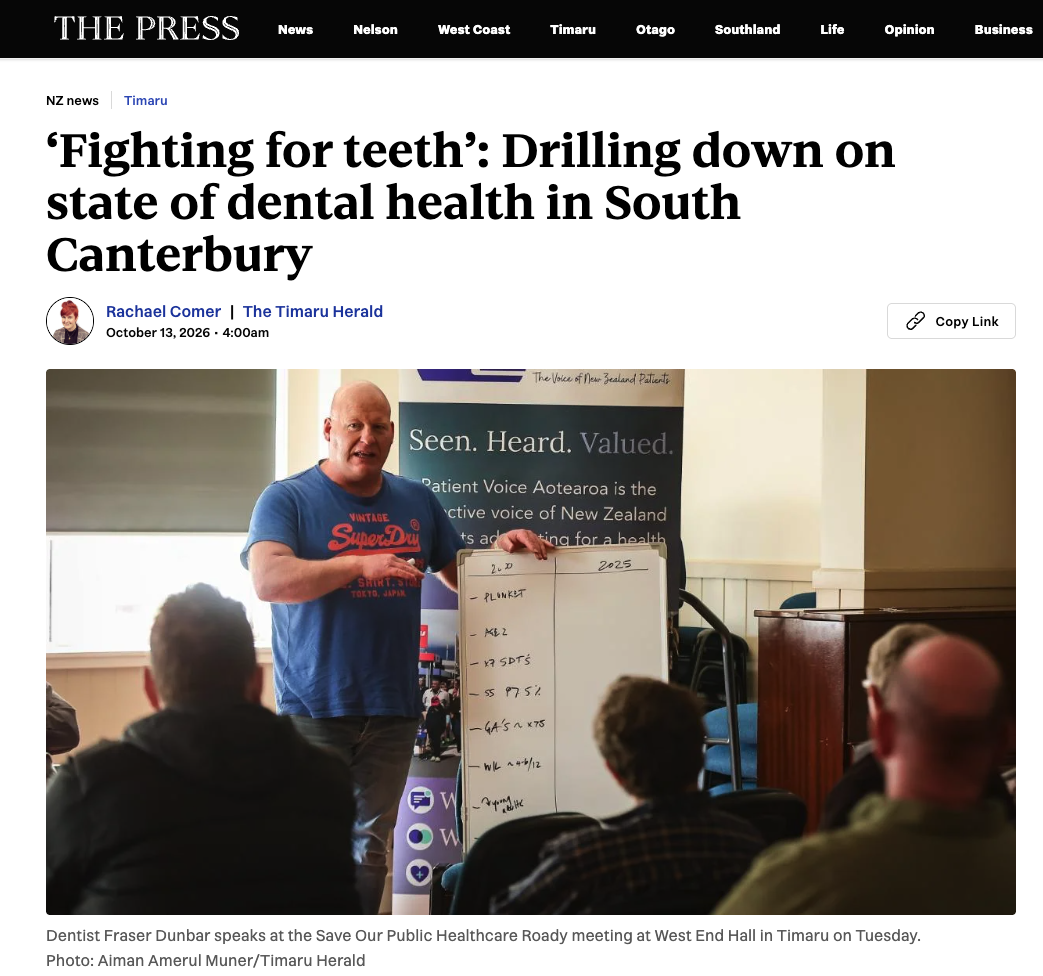
At the Roady meeting in Timaru, dentist Fraser Dunbar described routinely removing as many as 100 teeth in a single morning, while children as young as three were presenting with decay so severe that all their teeth needed removing. He said South Canterbury's school dental workforce had fallen from seven dental therapists to just 0.8 of a full-time position by 2025, while around 200 children each year required a general anaesthetic for dental treatment at Timaru Hospital.
The consequences extend well beyond childhood, with severe dental infections sometimes requiring emergency transfers, surgery and intensive care.
We know prevention works. We used to do it. So how did we end up here?
Read the Timaru Herald's Fighting for teeth: South Canterbury's dental crisis.
Mental health and addiction: an absence of care
Across the country, communities described mental health and addiction services that were either overwhelmed or entirely absent, with little evidence of coordinated planning to meet local needs. We heard deeply troubling accounts of young people who had attempted suicide but were unable to access the help they needed, alongside concerns about youth suicide and the lack of support available to families and others trying to help. A shortage of residential treatment facilities was another recurring concern.
There are promising local initiatives, including Sir John Kirwan's programme helping schoolchildren understand and manage their emotions, but these are not always adequately supported. What emerged was a picture of fragmented services, significant gaps in care and people struggling to find help when they need it most.
Privatisation: public money, private care
People who spoke with Kaitiaki Hauora expressed strong support for publicly funded and provided healthcare, alongside serious concerns about the increasing reliance on private providers. They questioned why more public money is being directed towards private healthcare while public hospitals continue to struggle with staffing, resources and access to services.
At the Roady meeting in Westport, Dr David Galler raised these concerns in the context of the difficulties facing rural communities. West Coast residents already have limited access to local specialist services, with some required to travel long distances for treatment, often facing additional costs for transport and accommodation.
The concern is that expanding private provision without strengthening public services risks leaving patients with an increasingly fragmented system, particularly in rural communities where access to care is already difficult. The message from those who spoke to us was clear: they want a stronger, properly resourced public health system that delivers care according to need, not ability to pay.
Zombie hospitals and waiting lists for waiting lists
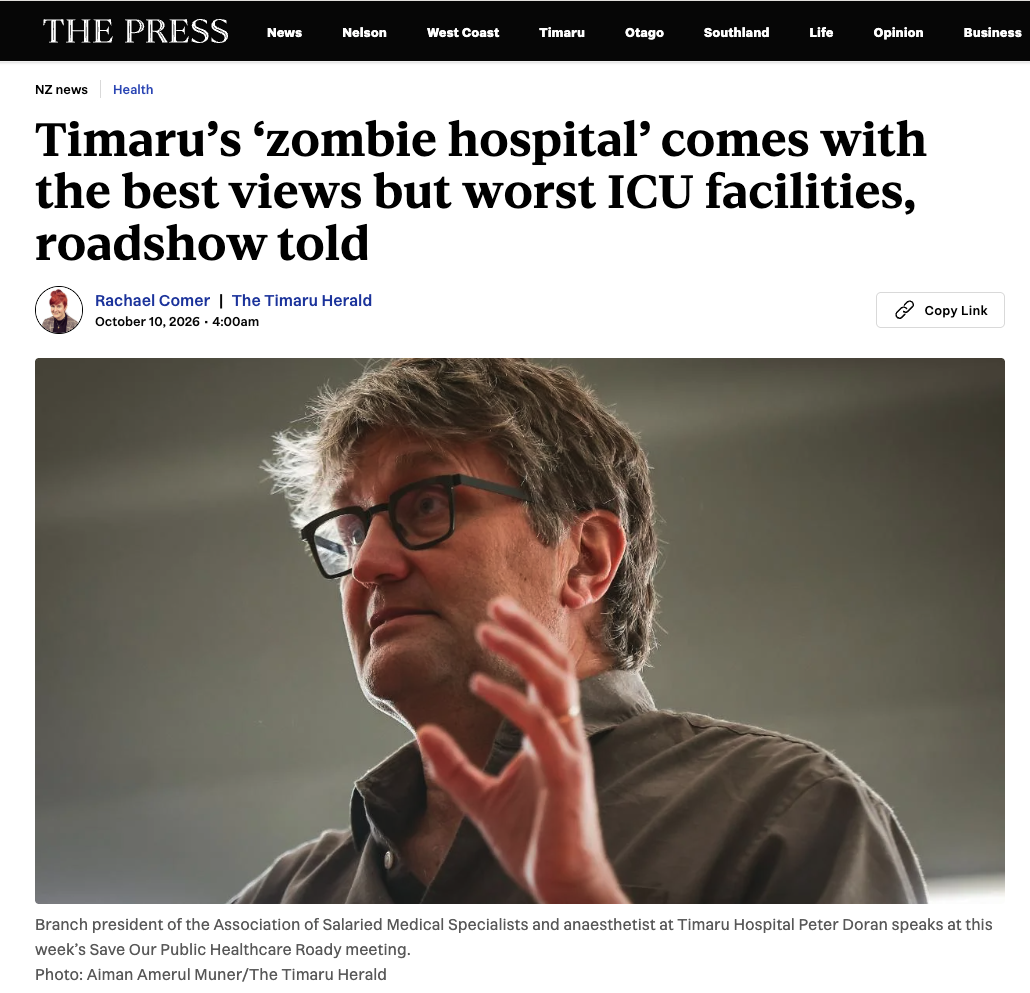
In Timaru, the local hospital was described in media coverage as a “zombie hospital”, still operating but struggling with the pressures facing its services. Across the country, health workers told Kaitiaki Hauora of hospitals facing workforce shortages, growing demand and poor coordination with other hospitals and community healthcare providers.
Shortages across clinical specialties are creating a vicious cycle. Increasing workloads lead to burnout and resignations, placing even greater pressure on those who remain. Staff are working extraordinarily hard to care for patients, but without the workforce planning, resources and coordination needed to deliver consistent care.
For patients, the consequences are serious. People face long waits for specialist appointments and diagnostic tests, while GP referrals are increasingly declined before patients can be assessed. Some GPs told us they had stopped referring patients altogether because they had so little confidence their patients would be seen. We are creating waiting lists for the waiting lists.
These problems were echoed across the Roady. In Southland, health workers described staffing pressures and difficulties accessing specialist services. On the West Coast, patients faced long journeys to receive care unavailable locally, while in Nelson, concerns were raised about patients having to become sicker before qualifying for treatment.
Hospital staff also questioned whether government performance targets reflect the true level of unmet need, particularly when patients cannot get onto waiting lists in the first place. What emerged was a picture of hospitals struggling to meet demand, with exhausted staff and patients caught in a fragmented system that is failing to work as a whole.
Health is about more than healthcare
In smaller towns across Aotearoa, communities described how poverty, poor-quality housing, low wages and limited employment opportunities, particularly for young people, are affecting people's health and wellbeing. They also raised concerns about the impacts of alcohol, methamphetamine, unhealthy food and the widespread availability of pokie machines.
These are not problems the healthcare system can solve on its own. What Kaitiaki Hauora heard reinforced the need for a much stronger public health approach that addresses the conditions in which people live, rather than focusing almost entirely on treating illness once it occurs. Improving health means investing in prevention, healthier communities and the social and economic conditions that allow people to thrive.
What people want
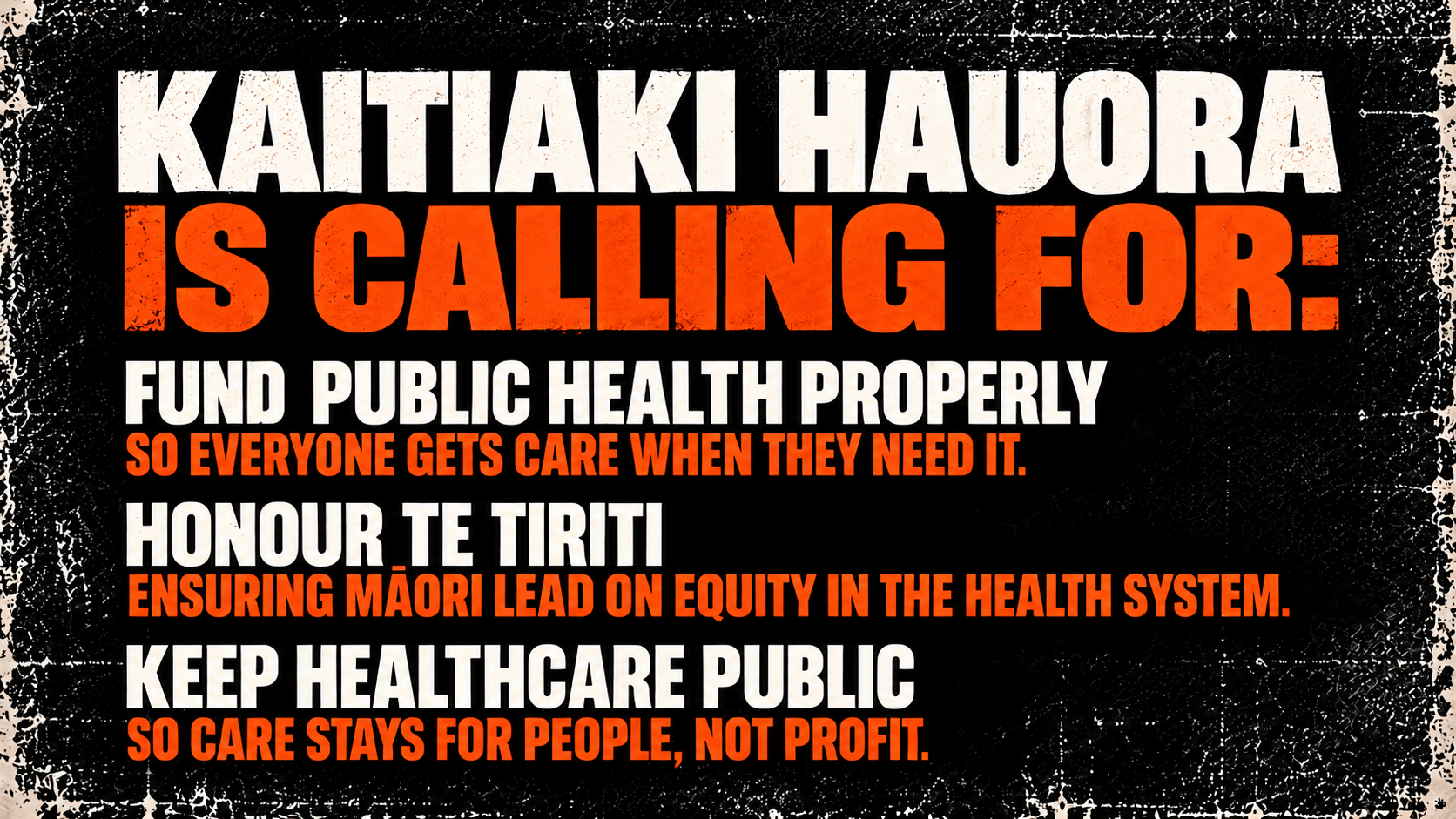
Despite the frustration, anger and loss of trust expressed throughout the Roady, people have not given up on public healthcare. They want a properly funded, coordinated system that responds to the needs of their communities, with Health New Zealand working alongside local providers, patients and whānau rather than making decisions in isolation.
Communities want clear local and regional plans, stronger connections between primary care, hospitals and specialist services, and meaningful involvement from healthcare workers in decisions about how care is designed and delivered. Above all, they want long-term planning and political consensus that puts the needs of patients and communities ahead of short-term decisions.
People aren't asking for the impossible. They're asking for a public health system that works.
The system must work for people, not the other way around
One of the clearest conclusions from the Roady is that our health system appears increasingly focused upwards, towards ministers and bureaucracy, rather than outwards towards the people it exists to serve. Decisions are being made without sufficient understanding of what happens on the frontline or what patients, whānau and health workers need to deliver and receive good care.
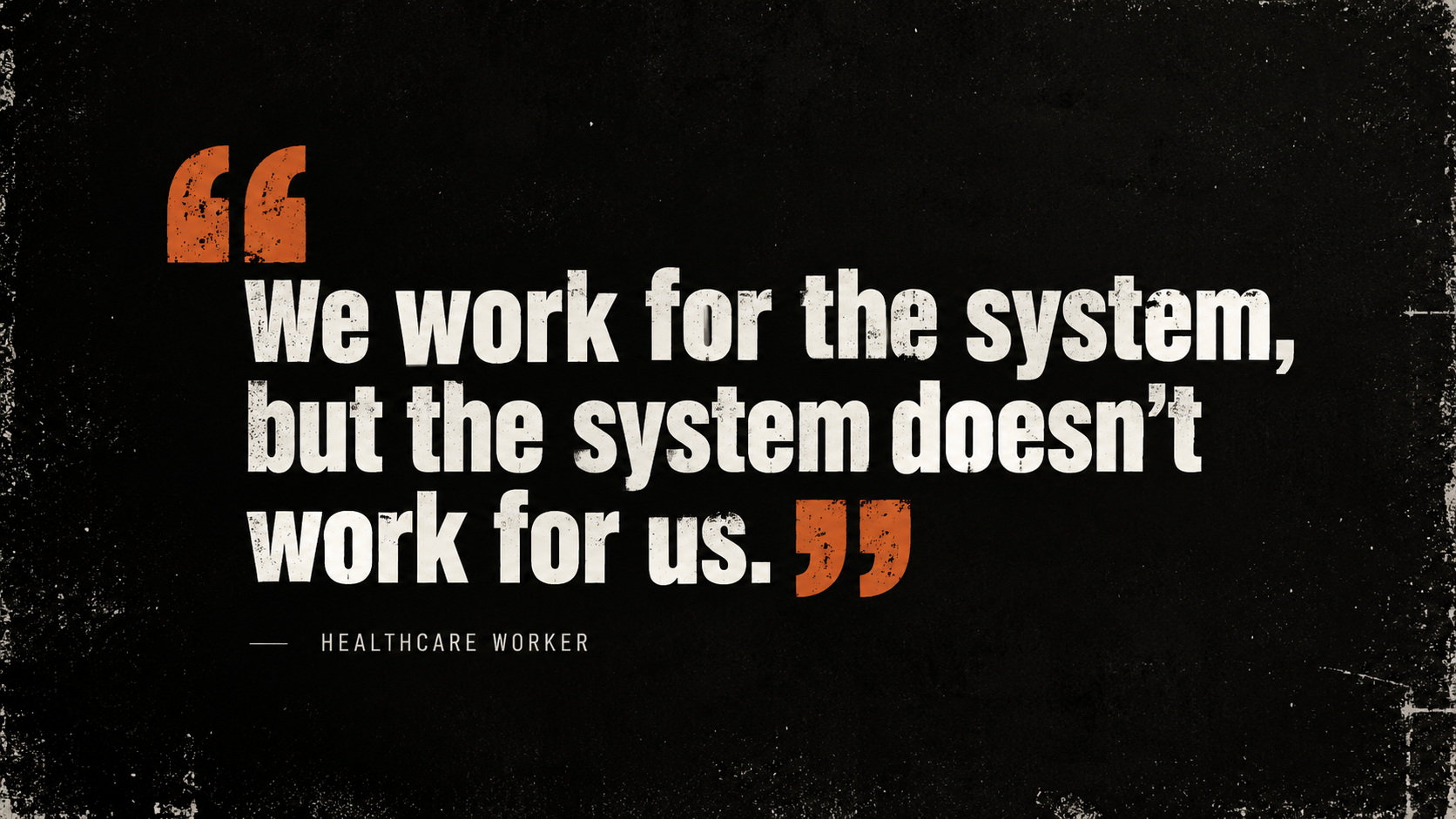
Throughout the journey, healthcare workers described feeling as though they work for the system, rather than the system working for them and the people they care for. Their experience, knowledge and understanding of local needs should be central to decisions about how healthcare is organised and delivered.
Ministers and health administrators have essential roles, but they are not the people providing care. Their responsibility is to listen to those who do, understand what is needed in different communities and ensure the resources, coordination and support are in place to make good care possible.
Ngā mihi nui
Our heartfelt thanks to everyone who welcomed the Roady into their communities, attended meetings, shared their experiences and spoke so openly about the challenges they face.
We especially acknowledge the patients, whānau and health workers who bravely shared deeply personal and sometimes painful stories. Speaking out isn't always easy, particularly for those working within the health system, and we are grateful for the trust you placed in us.
You deserve a public health system that listens to you, supports you and delivers the care you need.
Ngā mihi nui ki a koutou katoa.